The Shire in Real Life: Visiting the Hobbit Village in New Zealand
The Shire is a real place on a working sheep farm near Matamata. What was built, what burned down, what was rebuilt — and what actually survives from the films.
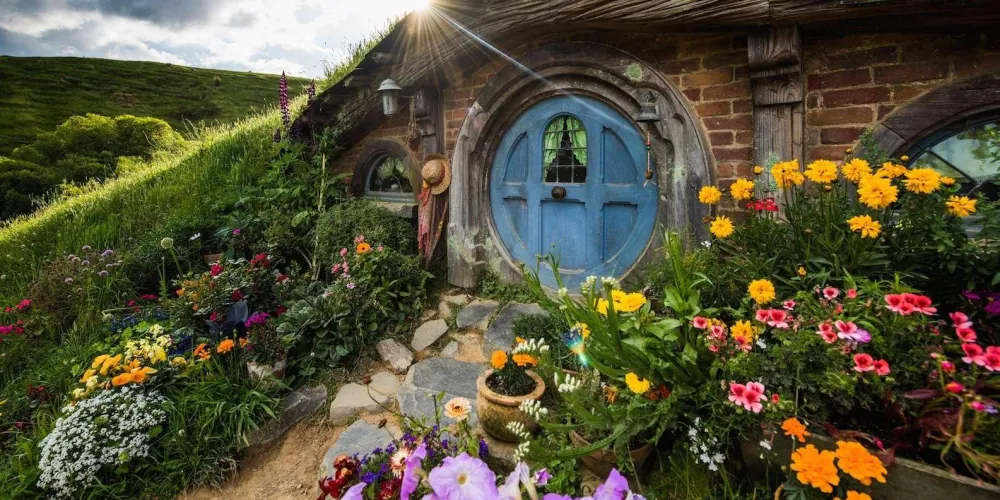
The Shire is a real place, and you can walk through it. It sits on a working sheep and beef farm near Matamata, in New Zealand’s Waikato region, about two hours south of Auckland. Forty-four hobbit holes are built into the hillside, the gardens are planted and weeded year-round, and the pub at the bottom of the valley serves beer.
What most people don’t know is how close it came to not existing at all — and how much of what you photograph there is younger than the tourism business built around it. This is the story of the place itself: what was built, what burned, what was rebuilt, and what survives.
If you’re past that and want tickets, tour options and how to get there, that’s covered separately in our complete guide to visiting the Hobbiton Movie Set.
Where the Shire Actually Is
The set occupies about twelve acres of the Alexander family farm, roughly fifteen minutes from Matamata town centre — although the address is technically Hinuera, which catches out a lot of satnavs. Tours leave from The Shire’s Rest, a converted woolshed on Buckland Road, a name that predates the films whatever the tempting link to Tolkien’s Buckland suggests.
In 1998, location scouts for The Lord of the Rings went looking from the air for hill country meeting one specific requirement: nothing modern in any sightline. No power lines, no buildings, no roads. They found it on a farm the Alexanders had owned since 1978, complete with a lake and a large pine above a natural amphitheatre. That absence is why the farm was chosen, and it’s still why the set photographs the way it does.
Other Experiences You Might Enjoy
A trip to Hobbiton near Matamata pairs naturally with the Waitomo Glowworm Caves, about 45 minutes south, or with Ruakuri Cave for travellers who want more time underground. Below are other highly rated tours and experiences worth adding to your Waikato itinerary.
The Shire Exists Because It Rained
Film sets are temporary — that’s the whole economic logic of building one. The 1999 Shire was built accordingly: 39 hobbit holes of untreated timber, plywood and polystyrene, over a nine-month build from March 1999, with the New Zealand Army cutting about a kilometre and a half of access road into the property. That road is still the route the buses take.
Filming ran for roughly three months from December 1999. Afterwards the crew came back to take it all down, exactly as planned.
They didn’t finish. Extended rain stopped the work partway through, leaving 17 bare plywood façades on a muddy hillside. Before anyone got back to them, people had started turning up at the farm gate asking to look — before the first film had even been released. The Alexanders began guiding them around the ruins, and by 2002 that had become a real tour business, running on nothing but weathered plywood and the promise of what had been shot there.
That decade of demonstrated demand is the reason the set exists today. When Peter Jackson returned in 2009 to film The Hobbit, the Alexanders were in a position to negotiate something no one had asked for the first time: that the rebuild be permanent.
What’s Real, and What Was Rebuilt
Two things are true at once here, and the honest version needs both.
It is the genuine filming location. The land, the contours, the lake and the great pine on the Party Field are the same ground that appears on screen.
But almost none of the standing structure is from the first trilogy. The operator’s own word for the 2009–2011 work is reconstructed, not preserved — a second-generation set, built a decade after the original by the same production, to look like the thing that had stood there. Some of it is newer still: the Green Dragon Inn opened in 2012, the walk-in interiors in December 2023, and neither has appeared on screen in any film.
None of that makes it fake. It does make “the original set” a phrase worth handling carefully.
The Green Dragon Burned Down — On Camera
The pub is the clearest case. There was a Green Dragon in the 1999 build, along with a mill and a bridge — and it was built to be flammable on purpose, because it was needed for the vision of the Shire in flames that Galadriel shows Frodo in her mirror. Per Wētā Workshop’s own account, that sequence was deliberately shot at Hobbiton after the rest of the Shire filming had wrapped, so the crew could burn the building down.
You cannot un-burn a building. Whatever the pub is today, it is not that one.
What stands now went up during the Hobbit rebuild as a themed shell intended only for filming, then was fitted out as a licensed venue — commercial kitchen, double-sided stone fireplace, hand-carved servery — opening in 2012. It’s an odd category of building: not the original, not a replica, but a real film structure finished afterwards for people to sit in.
The neighbouring double-arch bridge tells the same story. The 1999 version was scaffolding, plywood and polystyrene, built by the Army; the stone one there now was built for The Hobbit from permanent materials — though the stone itself, per the operator, is man-made from cement and animal fats.
The Three Trees
The oak above Bag End is the most photographed object on the site, and published accounts routinely confuse two entirely different trees.
For The Lord of the Rings, the production bought a mature oak from a nearby farm, felled it, numbered every branch, trucked it in and bolted it back together above Bag End. Artificial leaves were imported from Taiwan and wired on individually. Jackson decided the green was wrong and had the entire canopy hand-repainted.
By the time filming for The Hobbit came around, that dead tree had bleached and failed. It was replaced with a completely synthetic replica — steel frame, polyurethane foam, silicone — and deliberately built to look smaller and younger, because The Hobbit is set sixty years earlier. That is the tree in your photographs. It has never been alive.
The Party Tree, down on the field where Bilbo’s birthday scene was shot, is the exact opposite: a real, living pine that was growing there before anyone thought of filming, one of the features that made the scouts pick the farm, and still standing.
What You Can Actually Go Inside
Almost nothing, which surprises people.
Hobbiton is explicit: the hobbit holes are external façades, Bag End included. The famous round green door opens onto nothing, and visitors aren’t permitted up to it. Every film interior, Bag End’s parlour included, was a sound stage at Stone Street Studios in Wellington.
The exception arrived in December 2023, when two walk-in interiors opened at Bagshot Row — excavated behind existing façades into a waterproof concrete bunker under the hillside, with an entry hall, two bedrooms, bathroom, kitchen and pantry, and a parlour with a fireplace. They were designed at 83% scale by the people who made the films, and there are two identical ones so a guide can split a group in half.
They’re beautifully done, and they were unambiguously built for visitors rather than for camera. Sam Gamgee’s yellow door beside them is still a façade.
It’s Still a Farm
This gets forgotten because the set is so tended, but the surrounding land is a working farm — somewhere between 1,200 and 1,400 acres depending on the source, running sheep and Angus cattle, still owned and worked by the Alexander family. Tourism operates as a partnership with Peter Jackson; the farm underneath does not.
Stock movements are planned around tour departures, and mobs of well over a thousand ewes are driven along the same track the buses use. The recurring complaint from the farming side is tourists leaving gates open.
It’s also the largest single employer in the Matamata area, and in 2025 Guinness World Records recognised it as the largest purpose-built film set in the world, at 5.5 hectares.
Matamata itself has leaned in: the town’s information centre is built as a hobbit hole, designed by Lord of the Rings production designer Dan Hennah and funded by roughly NZ$250,000 of community fundraising — a fake building better documented than most of the real set.
For One Week in 2026, It Was a Film Set Again
In July 2026 Hobbiton closed to visitors for about a week. The operator confirmed why on its own social channels: the production crew for The Lord of the Rings: The Hunt for Gollum, directed by Andy Serkis, was shooting there, with Hobbiton staff pulling on hairy feet as extras.
It was the first time since 2011 that the Shire was a working film set rather than a preserved one. It’s also over — the set reopened, tours are running normally, and events are on sale into 2027. Beyond Serkis, nothing about the shoot has been confirmed.
The Other Places People Mean
Plenty of travellers searching for “the Shire” are actually thinking of somewhere else, and the important thing to know is that Hobbiton is the only place in New Zealand where a film crew built something that is still standing.
That’s not sentiment, it’s consent conditions. Filming on public land required temporary sets to be removed completely, which is why nothing remains at Mount Sunday, which played Edoras, or at Kaitoke Regional Park, which played Rivendell — the archway there was added afterwards for visitors, not a film artefact. Mount Victoria in Wellington, where the “get off the road” scene was shot, is free, signposted and entirely unbuilt.
Closer to the caves, the Denize family’s farm at Piopio — the Trollshaws and Staddle Farm in The Hobbit — sits inside the Waitomo district and is visitable by guided tour only. It’s the structural opposite of Hobbiton: real landscape, nothing built, nothing surviving but the land itself. It’s also the one Middle-earth location that pairs naturally with a day at the Waitomo Glowworm Caves rather than a Matamata detour — and if you want both famous sites in one day, that’s our Waitomo and Hobbiton combo day-trip guide.
One correction while we’re here: Amazon’s The Rings of Power was not filmed at Hobbiton.
Frequently Asked Questions
Can you go inside Bag End at Hobbiton?
No. Bag End is a façade — its round green door doesn’t open, and visitors aren’t permitted up to it. Every film interior, Bag End’s parlour included, was shot at a sound stage in Wellington, not on the farm. The only real walk-in interiors anywhere on the set are the two Bagshot Row hobbit holes that opened in December 2023, purpose-built for visitors at 83% scale. For everything else on planning a visit — tickets, tour length, what’s included — see our complete Hobbiton Movie Set tours guide.
So Is It Really the Shire?
It’s a working farm with a film set on it, kept standing by an accident of weather and maintained since by gardeners rather than a film crew. Most of what you’ll photograph postdates the trilogy that made it famous, and the most iconic object on the site is an artificial tree standing where a real one was once hung with imported leaves.
And yet the hills are the hills the scouts chose in 1998 precisely because nothing modern intrudes on them, the pine on the Party Field is the one in the film, and the whole place survives because enough people wanted to look at seventeen sheets of weathered plywood in a paddock.
Real is a slippery word here. Permanent is the more interesting one.
Planning a Visit
Now that you know what’s actually there, the practical side lives on our Hobbiton Movie Set tours guide — ticket prices, the standard tour versus the Evening Banquet, getting there from Auckland or Rotorua, and honest advice on whether it’s worth it. Many visitors pair the trip with the Waitomo Glowworm Caves, about 45 minutes south, in a single Waikato day — see our Waitomo and Hobbiton combo day-trip guide for how to fit both in.
Book Your Waitomo Caves Experience
Rated 4.5/5 from 79 reviews, this seven-hour day trip from Auckland takes you through the Waitomo Glowworm Cave and onto the boat under the glowworms.
Check Availability & Book