Where to See Glowworms in New Zealand (Not Just Waitomo)
Glowworms glow all over New Zealand — in show caves, roadside dells and wild caves you can walk into for free. Here's where to see them on both islands, and how to choose.
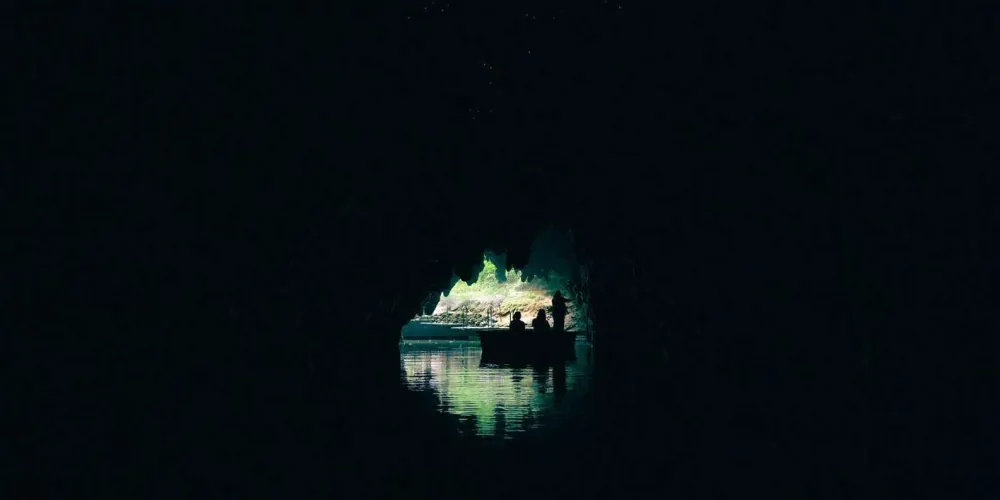
Waitomo is the famous one, but glowworms are not rare in New Zealand. They live in damp, dark, sheltered places across both islands — limestone caves, bush gullies, old railway cuttings, the underside of a natural rock arch. Some of the best displays cost nothing and need no booking. You can be standing under one twenty minutes after dinner.
This is a guide to where you can actually see them, what each place costs, and how to pick the one that suits you. Prices below are in New Zealand dollars, taken directly from operators and checked in August 2026. If you are starting from Auckland, the calendar below is for a day trip that includes the Waitomo Glowworm Cave.
What You’re Actually Looking At
They aren’t worms. Arachnocampa luminosa is the larval stage of a fungus gnat, found nowhere else in the world, and the Māori name is titiwai — “lights reflected in water.”
Each larva hangs a nest of silk threads beaded with mucus and glows blue-green to lure small flying insects into them. The light is a fishing lure, and the caves with a river running through them — more insects, more food — tend to have the displays people remember.
Two practical consequences follow. Glowworms need darkness and stillness, so noise and torchlight genuinely dim a display. And they don’t have a season: there is no wrong month to go.
Other Experiences You Might Enjoy
Glowworms are usually one stop on a bigger New Zealand trip. If Waitomo is your base, it pairs naturally with the Ruakuri Cave walking tour a few minutes down the road, or with the Hobbiton Movie Set near Matamata for a full Waikato day. Heading further south, Te Anau and Fiordland sit near some of the South Island’s best glowworm and cave experiences. Below are other highly rated tours and experiences worth adding to your itinerary.
Waitomo: The Anchor, and Three Ways to Do It
Waitomo in the Waikato is where the concentration is greatest and the infrastructure is oldest, about two hours south of Auckland.
The Waitomo Glowworm Caves boat tour is the classic — 45 minutes, a silent drift through the grotto, a maximum of 23 people to a boat, NZ$85 adult and $39 for children 4–14. It’s also the busiest glowworm site in the country by a wide margin, taking around half a million visitors a year. There’s more detail on the boat tour and what the visit involves on our Waitomo caves guide and in what to expect on the day.
The Ruakuri Cave is the two-hour walking alternative nearby, NZ$122 and $46, and it is the only wheelchair-accessible glowworm cave in New Zealand — a route never steeper than 1:10, with a chair limit of 65cm wide by 130cm high set by the lowest point of the ceiling. The spiral entrance ramp that makes this possible exists for cultural reasons rather than engineering ones: the cave’s natural entrance is a wāhi tapu and urupā, so a 60-metre helical drum was built a safe distance away and tours never approach it. We compare the two caves properly in Waitomo Glowworm Caves vs Ruakuri.
Spellbound is the small-group option, 15km from the village on private farmland at Mangawhitikau. Groups cap at twelve. NZ$79 for the 90-minute tour or $99 for the longer version that adds Te Ana o te Atua, a dry cave of formations and fossils. Its real distinction is that you can bring a camera — more on that below.
There are also two free walks within a few kilometres: the Ruakuri Walk, a 1km loop DOC times at 45 minutes, and Mangapōhue Natural Bridge, 700m return through a limestone arch with glowworms on its underside. Worth knowing that DOC’s own pages for both describe the walks without mentioning glowworms at all — the night display is well attested by visitors, but it isn’t an official claim.
Northland
Waipū Caves is the best-known free wild cave in the north: unlit, unstaffed, open all hours, about two hours from Auckland. You need a torch, a spare torch and shoes you don’t mind soaking. DOC’s warning is not boilerplate — the system is “prone to flash flooding,” and in November 2022 vehicles were submerged in the reserve carpark itself.
Confusingly, there is a separate Waipu Caves Farm Park on a different property with a different cave, opened to visitors in 2023. That one is guided, has a concrete path and handrails, supplies torches, and costs NZ$45 adult and $30 child. If you want Waipū without the wading, that’s the one you want.
Kawiti Glowworm Caves at Waiomio, near Kawakawa, is Māori-owned and Māori-guided — not a concession or a partnership, but a family operation on Ngāti Hine ancestral land, with the surrounding hills tapu as burial grounds. The daytime tour is 45 minutes, NZ$50 and $30. A twilight tour at NZ$200 includes observance of protocol at Kawiti Marae, kōrero on traditional healing and a shared meal. It’s also one of the few glowworm caves in the country you can reach without a car, via transfers from Paihia and Waitangi.
Bay of Plenty
McLaren Falls Park near Tauranga has a free glowworm walk on the Waterfall Track, and one scheduling trap worth knowing: the council gates close at 7:30pm during daylight saving and 5:30pm in winter, and you must be inside before they close. In midsummer, full darkness arrives well after the gates shut. Winter is the easier free visit here, which is the reverse of the usual advice.
Waimarino runs evening kayak tours from inside the park to Mangapapa Canyon, which is only reachable by water — NZ$265 for the evening glowworm tour or $170 for the shorter Big Kanu trip, minimum age eight.
The South Island
The South Island is where most glowworm lists go thin, and it shouldn’t.
Te Anau Glowworm Caves in Fiordland is the southern equivalent of Waitomo: a catamaran across the lake, then a guided walk and a small-boat ride inside the cave. NZ$145 adult, $69 for children 5–15, two and a quarter hours door to door. Its quiet advantage is a maximum of twelve guests per guide, unusually low for a flagship show cave.
Underworld Adventures at Charleston on the West Coast is the South Island’s adventure option, reached by a narrow-gauge rainforest train. Cave rafting is NZ$245 with a minimum age of ten; a walking glowworm cave tour is NZ$165 with a minimum age of five, which makes it one of the few genuine family options outside a show cave. Note the train sold on its own does not include cave access.
For free, the Hokitika Glow Worm Dell sits a kilometre from town on SH6, a flat 50-metre track from a sealed carpark, and is about as close as New Zealand gets to an accessible glowworm site. It is also the busiest free site on the coast, and crowding genuinely spoils it. There’s a quieter twin inland — the Rimu, or Woodstock, dell — where you park at the Woodstock Hotel about eight minutes from Hokitika and walk 230 metres to a tunnel cut in the cliff. Fewer glowworms, far fewer people, no fence and no official page.
Clifden Caves in Southland is a free, DOC-managed 1km limestone system for fit, agile visitors aged twelve and up. Treat DOC’s rainfall rule as absolute: do not enter if rain is forecast for the day of your visit, if it is currently raining, or if it has rained within the past 24 hours. That bars entry on a forecast, so a dry morning isn’t enough. DOC also advises that after the March 2025 earthquake the cave is safe to enter but has unstable surfaces and loose debris.
How to Choose
If you want photographs, this is the sharpest divider, and it isn’t the one people expect. Waitomo Glowworm Caves, Te Anau and Kawiti all ban cameras outright. Spellbound advertises itself as camera-friendly and provides fixed mounts; Ruakuri allows photography in selected zones without tripods; every free site is unrestricted. The rule isn’t big-operator-bans, small-operator-allows — Kawiti is a small family business with the firmest ban of all, on the grounds that light disturbs the glowworms.
If accessibility matters, Ruakuri is the only genuinely wheelchair-accessible cave, with Hokitika’s dell the easiest outdoor option and Mangapōhue’s boardwalk described by DOC as pushchair-friendly. There’s an awkward catch at Ruakuri: coach day tours from Auckland and Rotorua go to the Glowworm Caves only, so the one accessible cave is also one you essentially need your own car to reach.
If you don’t drive, the reliable options are Waitomo Glowworm Caves, Te Anau, Kawiti and Spellbound. The free walks are the hardest — none has a scheduled tour after dark.
If the weather turns, it works backwards from what you’d assume. The outdoor dells are safe in rain and often better for it, since humidity brightens the display. It’s the wild caves — Waipū, Clifden — that become dangerous. Show caves are unaffected either way, which is worth remembering when you’re picking a wet-day activity; see also the best time to visit Waitomo.
One Place You’ll See Recommended That You Can’t Visit
Abbey Caves near Whangārei still appears on most “free glowworm caves” lists. It has been closed under a rāhui placed by Ngāti Kahu o Torongare and Whangārei Hapū since May 2023, after a fifteen-year-old student drowned there on a school trip, and there is no confirmed reopening. Don’t plan around it.
One smaller trap: Aranui Cave at Waitomo is sold within combo tickets and is a fine limestone cave, but it has no glowworms. People buy it expecting them.
Frequently Asked Questions
Can I see glowworms in New Zealand for free?
Yes. Waipū Caves in Northland, the Ruakuri Walk and Mangapōhue Natural Bridge near Waitomo, McLaren Falls Park near Tauranga, and the Hokitika Glow Worm Dell on the West Coast all cost nothing and need no booking. The trade-off is that none has a scheduled after-dark tour, so you’re relying on your own torch, timing and — at the wild caves — a genuine read of the weather. Waipū and Clifden Caves are both closed by DOC in or after rain; the outdoor dells are the safer free option if conditions are uncertain.
Before You Go
Give your eyes ten minutes. At outdoor sites, wait at least an hour after sunset and then stand still in the dark — the display resolves slowly, and walking in with a phone torch on ruins it for you and everyone else.
Use red light if you have it, keep your voice down, and never touch the threads. At the free sites, check the forecast before you commit, and tell someone where you’re going if you’re heading into an unlit cave alone.
Make It Part of a Bigger Trip
If Waitomo is your anchor for glowworms, it’s worth building the rest of a Waikato day around it. The Waitomo Glowworm Caves boat tour and the Ruakuri Cave walking tour pair naturally with each other, and many visitors combine both with the Hobbiton Movie Set less than an hour away. See our Waitomo + Hobbiton combo day-trip guide for how to fit it all into one day, or check current availability for the Waitomo boat tour below.
Book Your Waitomo Caves Experience
Rated 4.5/5 from 79 reviews, this seven-hour day trip from Auckland takes you through the Waitomo Glowworm Cave and onto the boat under the glowworms.
Check Availability & Book